
An industry study* reports that 71% of patch cords in a patch field have a bend radius of a 1/4" or less.
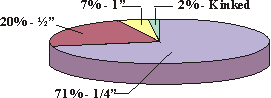
*Excerpts of this study were published in Cabling Installation & Maintenance, February 1997, "The Reality of Patch-Cord Management."
Where do the Tightest Bends in Patch Cords Occur in
a Patch Field?
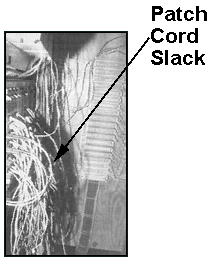 |
1. At the patch panel or equipment (hub) interface connector and patch-cord plug. This is where excess slack from patch cords lies upon the cords plug-in, causing a tight bend radius. |
| 2. With horizontal managers, the distance (depth) between the end of the distribution ring, routing clip, or channel on the horizontal manager and the patch panel (connector interface) leads to tighter bend radii. | 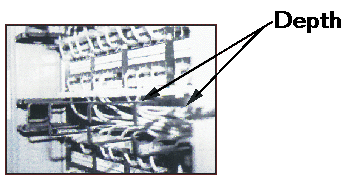 |
| 3. When patch cords are too long, slack is stuffed into the vertical management system. |  |
| Additionally, outside of the patch field, congestion occurs at the workstation, where patch cords connect computers to the network. These are highly congested areas. The cords are compressed into tight bends. |  |
The Nature of the Beast
Subjugation to tight bends is inherent to patch cords. This occurs in accomplishing the task at hand, whether relocating a patch cord in a patch field or plugging a cord in the jack behind a desk. This phenomenon can easily be examined on your company or customer’s patch cords. The tight bending of patch cords is expected and always compensated for in the manufacturing process, whatever category cables are used.
Going Beyond Logic
We at PerfectPatch, Inc., realized this when developing the industry’s first patch-cord adjuster, the PerfectPatchTM (PP-350), which incorporates a 1/4" bend radius. Logic confirms that patch cords must be able to bend at a 1/4" radius without degrading transmission performance of networks. However, PerfectPatch, Inc., is constantly researching and performance testing to verify this logic to be correct and repeatable as the new technologies such as Gigabit Ethernet come on line. The results are backed with third-party independent laboratory testing and the industry’s most sophisticated patch-cord tester - the PCT-350 system.
TIA/EIA-568-A Myths About Patch-Cord Bend Radius
In the original TIA/EIA-568 standard (July, 1991), bend radius did not come into play. The subject was not addressed until TSB-40 ("Additional Transmission Specifications for Unshielded Twisted-Pair Connecting Hardware," August, 1992). "In spaces with UTP terminations, cable bend radii shall not be less than eight-times the cable diameter." This equates to approximately 2" radius or 4" diameter.The current TIA/EIA-568-A standard (October, 1995) (Section 10.6.3.2) reads as follows: "In spaces with UTP terminations, cable bend radii shall not be less than four-times the cable diameter for horizontal cable." This equates to approximately 1" radius or 2" diameter.This requirement is for only terminated spaces, such as when a cable is terminated at an outlet or on a patch panel. This requirement does not apply to patch cords. There is no bend-radius requirement for patch cords.
Why Such a Radical Change of Bend Radius From TSB-40 to the 568-A?
Realizing that eight times the cable diameter in a terminated space is just too large to achieve in the real world (you would have to replace all single gang outlet boxes). The TIA committee for the 568-A draft document at the time used Section 10.2.3.4, which reads: "The diameter of the completed cable shall be less than 6.35mm (0.25 in.)" and Section 10.2.3.6, "The cable tested in accordance with ASTM D 4565 Wire and Cable Bending Test shall withstand a bend radius of 25.4mm (1 in.) at a temperature of -20°C +/- 1°C without jacket or insulation cracking."
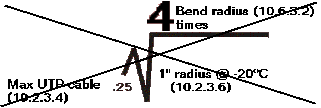
This requirement only evaluates cable jackets for cracking at temperatures far beyond what is experienced in equipment rooms and does not address the electrical performance of the cable. There is no requirement in this standard for patch-cord bend radius, but the industry embraced the only information it had (although it was wrong) and applied it to every aspect of the cabling system.
The Myth the 568-A Has Imposed on Solid Patch Cables Not Having an Adequate Flex Life
The current 568-A only allows for stranded conductors for use in UTP patch cords, as seen in Section 10.5.3, "To assure adequate flex life, cables used for UTP patch cords shall have stranded conductors." This was found to be inaccurate and will be edited to include solid conductors. This is based on the future ICEA S-90-661-199X (Section 2), which is scheduled for ratification. Look for solid patch and stranded cables in the future 568-B standard.
|
Home
| Design & Installation | Programs
| Instructions | Distributors
| The Developers | Gallery
| Questions | Email Us
|